


Before we get lost in the deep recesses of my mind, I wanted to share a small update to my last article about Outlook reactions.
Because this showed up in my email shortly after sending that issue out:
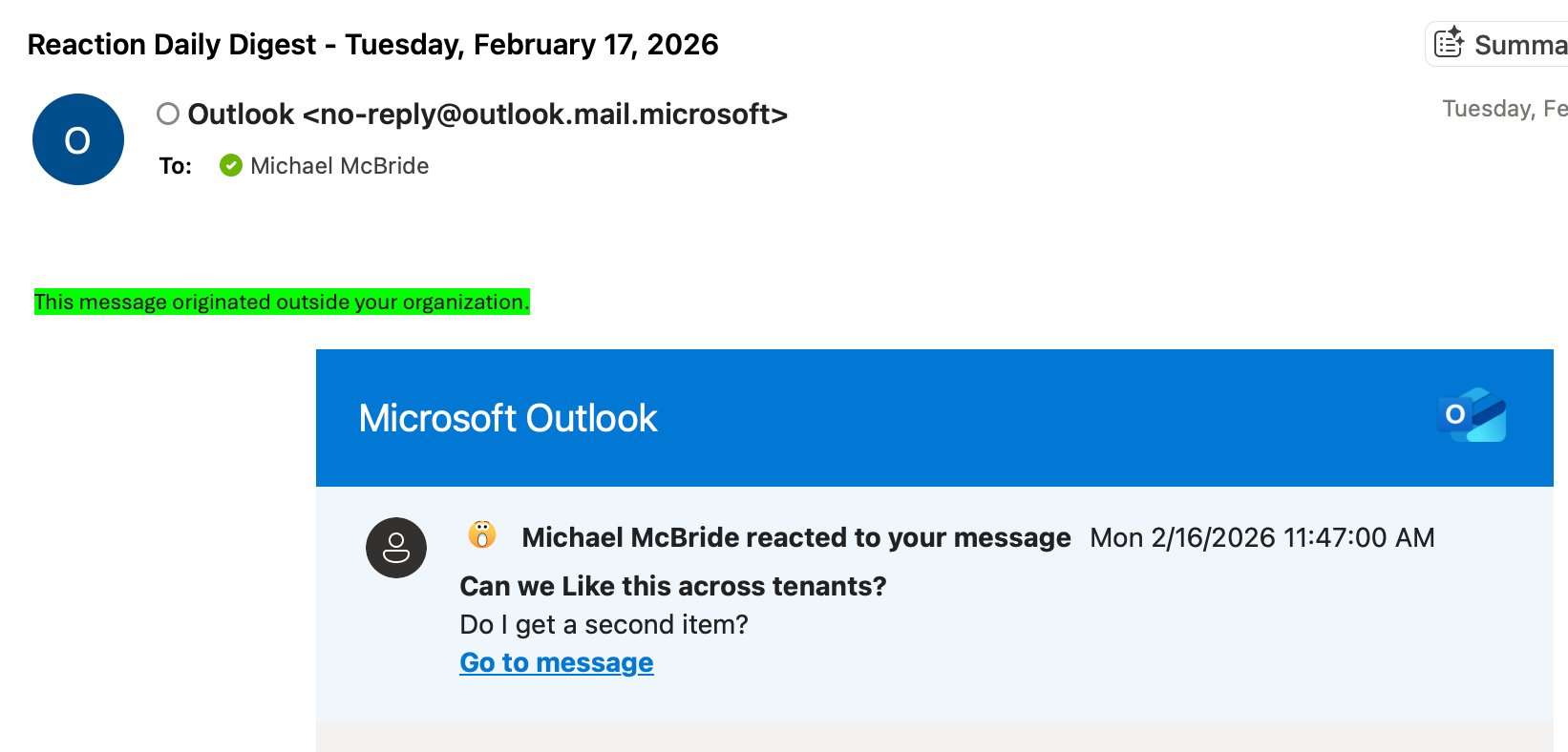
Yes, a daily digest email showing me reactions to my previous-day email messages. I’ve never seen that before. It hasn’t shown up in other environments when someone reacted to my email before, and I’m not sure it reliably exists. But, there it was.
Color me even more confused.

Later this week, I’m presenting to a local group about the many ways users can collaborate in M365, even when they may not even know they’re using the tool. Loop is, of course, the center of the presentation, because it shows up in so many places, even if you never open the Loop app or know it exists.
Every time I give a presentation like this, I’m always thoughtful about the governance side of Loop Workspaces, Pages, and Embedded Containers, because, frankly, it can be a bit overwhelming to consider.
It also reminds me that, during testing, I was able to search for and collect Loop content in the SharePoint embedded space, but only because my tenant is small enough that running a tenant-wide search for a keyword is not unreasonable.
For many of you, running a search like that may be a non-starter. I’ve talked to folks from large orgs with tens of thousands of users who will never run a search like that; thus, content in embedded containers is essentially uncollectable. (Not to mention the need to know what key terms to use with your search to begin with!)
Of course, it’s not just Loop. It’s also the difficulties in collecting Copilot interactions, chat message metadata, shared files across different channel types, linked chat, SharePoint versions, Planner tasks, and audit logs. That list doesn’t even include the various policies that may be in place and impact collection, such as short retention schedules, priority deletions, and other compliance rules.
My point is that collecting data from complex ecosystems like this is a multi-disciplined role. You’re not just the eDiscovery professional, you’re also the technical expert on how all of these tools work and store data, the security expert who identifies who has access to the relevant data, and the information governance expert who understands the lifecycle of data in the environment.
Frankly, that’s asking a lot. I don’t think it's sustainable. What is sustainable is a partnership, working with the people who are experts in those other areas, and with the custodians, to identify where they were working and creating data.
The question I have for small to mid-sized organizations, though, is whether those experts exist. Is there someone who understands where Copilot Pages are stored, where Teams data is stored, or what a Copilot interaction looks like in the Exchange mailbox? What about those custodians? When they say “I saw that in Teams,” do they know the difference between chat, channel posts, a shared file, meeting notes, etc.? Because it matters. Collecting every possible location related to a user in Teams because they can’t tell you where in Teams they saw that super relevant message.
It’s daunting to me to think about how I could build the most exhaustive custodian interview process, connect with every other IT and related expert in my organization, and still not have enough knowledge to properly collect relevant data for litigation.
If it were you, where would you direct them to find that expertise? Who out there is equipped to assist these organizations with eDiscovery collections fully?
And if those resources aren’t realistic, what should the courts consider reasonable?
These are the things I think about. It’s entirely possible that I’m not normal, and now you get to see inside the madness that drives me to do this testing and write this newsletter, because we all need to know more.
If you want to help in this journey, share the newsletter. Also, sign up for the Teams channel and join the conversation there. Let’s build a community that helps folks overcome some of these hurdles!